HOUSING | APARTMENT LIVING | DOGS
If Your Dog’s Barking Has Become a Lease Problem, the Cause Is Rarely What Owners Assume
A veterinary behaviorist explains the pattern she sees in every shared-wall building-and why the calming products you’ve tried were designed for the wrong problem.


If you’ve ever come home to an unsigned note on your door about your dog’s barking, you already know the feeling. The stomach drop. The hallway paranoia. Every neighbor suddenly a suspect.
You’re not alone. And this is more common than you think.
If your dog only erupts when you leave for the office or open a laptop…
If every delivery sets off a barking spiral that echoes through walls thin enough to hear your neighbor sneeze two units over…
If you’ve tried calming chews-three different brands, maybe four-and your cabinet looks like a graveyard of products that did absolutely nothing…
If you’re checking your phone after every shift, waiting for the next text from the leasing office…
Then what you’re dealing with may not be what you think it is.
Dr. Sarah Kessler is a veterinary behaviorist who has spent 15 years working with reactive dogs in apartment buildings. In the last three years, she’s seen an explosion of one very specific type of case.
And she wants to explain what’s actually happening-because the answer surprised her too.
Dr. Kessler works almost exclusively with dogs in shared-wall environments. High-density apartments. Condos with thin floors and thinner walls. Buildings she calls “shared acoustic chambers with individual rent payments.”
The cases flooding her practice all look the same.
The dog is well-trained. The owner is responsible-often a remote or hybrid professional who has tried everything. White noise machines. Frozen Kongs. Three different calming supplements. A training program. Sometimes two.
And yet: the second the owner opens a laptop, or a delivery truck pulls up, or a hallway door slams-the dog erupts. Full, sustained, wall-penetrating barking. Twenty minutes of it. Sometimes longer.
The owner has done everything right. And it’s still not working.
“These are not bad dogs,” Dr. Kessler says. “And these are not bad owners. What I kept seeing was a pattern that didn’t fit any standard anxiety diagnosis. These dogs were calm on weekends. Calm in the evenings. But Monday through Friday, during work hours, they were a completely different animal.”
She started calling them environment pattern cases. And she realized the problem wasn’t the dog’s temperament.
It was a mismatch between the environment and every solution the industry had been offering.
Here’s what Dr. Kessler’s investigation uncovered.
Almost every calming product on the market-chews, drops, treats, sprays-was formulated for rare, episodic stress events. Thunderstorms. Fireworks. Vet visits. Travel. Things that happen a handful of times per year.
The instructions on every label say the same thing: “Give 30 minutes before a stressful event.”
But apartment dogs in remote-work households don’t face rare events.
They face daily, repeating environmental trigger loops. Delivery drivers pulling up at 10 AM. Hallway footsteps at noon. A neighbor’s door slamming at 2 PM. The elevator dinging. The owner’s voice shifting into meeting mode. These happen multiple times a day, on a schedule that resets every Monday.
“The entire calming supplement industry,” Dr. Kessler explains, “has been prescribing event-based solutions for a schedule-based problem. It’s like handing someone an umbrella and sending them into a flood.”
This is why those products “did nothing.” Not because they were scams. Not because something’s wrong with your dog. But because using a product designed for a one-time emergency to address a chronic daily pattern is structurally incapable of working.
There’s nothing wrong with your dog.
Your dog’s nervous system is responding exactly as designed-to an environment it was never prepared for.
And once that clicks, everything about your experience in that apartment starts to make sense.

Think about the solutions you’ve already tried. They probably fall into one of four categories:
Calming chews from the pet store or Amazon. Designed to be given 30 minutes before fireworks. But there’s no 30-minute warning before a hallway door slams or a delivery driver approaches your building. By the time the trigger hits, it’s already too late.
Sedative-style supplements. These suppress the dog entirely. But you don’t want a zombie who doesn’t respond to anything. You want a dog who hears normal apartment sounds and can regulate itself instead of going nuclear.
Training alone. Correct direction, long-term. But training cannot override a nervous system that’s already operating at a nine out of ten before the first trigger even hits. The dog is primed before the hallway door opens.
CBD oils. Regulatory uncertainty. Erratic absorption. And still used as reactive, one-time dosing-the exact same flawed approach wrapped in different packaging.
Every one of these addresses individual triggers. None of them addresses the baseline arousal state that makes those triggers explosive in the first place.
If you’ve spent money on products that did absolutely nothing-if you’ve felt stupid for buying them, or like a fool for hoping again-your skepticism wasn’t misplaced. Those products failed because they were built for the wrong problem. And now you know why.
What Dr. Kessler and a growing number of behaviorists now recommend is a fundamentally different approach.
Instead of reacting to triggers after they hit, lower the dog’s baseline arousal level before triggers occur.
Think of it this way: if your dog’s nervous system is sitting at a nine out of ten when the day starts, every small stimulus-a door, a voice, a footstep-pushes it over the edge instantly. There’s no room left. But if you can bring that baseline down to a four or five over a period of consistent daily support, the same triggers still register-but the dog has room to absorb them, process them, and settle.
Dr. Kessler calls this a “behavioral bridge.” The daily support lowers the physiological floor so the training you’re already doing can take root during real-world triggers-instead of collapsing the second someone knocks on a wall.
The dog settles faster. Recovers quicker. Remains responsive and alert-not sedated, not checked out, just composed enough to let the moment pass without spiraling into twenty minutes of barking.
It’s not a hack. It’s a routine. And for apartment dogs dealing with daily triggers, it’s the first approach that actually matches the problem.
The obvious question is: if daily baseline support makes so much sense, why don’t most calming products work this way?
Because event-based products sell more units per panic purchase. A dog freaks out during a thunderstorm, the owner rushes to the store, grabs the first bag on the shelf. The business model doesn’t require reformulation.
Building a formula around daily use requires different ingredient logic entirely-botanical compounds dosed for sustained baseline support across weeks, not acute sedation in a single dose. It requires veterinary input. And it requires publishing every ingredient at its exact dosage, not hiding behind a proprietary blend.
Most companies never bothered.

PawShift is one of the first supplements built specifically for this use case.
It’s a daily soft chew-not an emergency product. Seven active ingredients at published doses. No proprietary blends. No CBD. No artificial colors or preservatives.
The hero ingredient is Valerian Root at 200mg, supporting GABA activity-the same calming pathway the dog’s nervous system uses to settle naturally.
Melatonin is capped at 2mg: enough to support cortisol regulation, low enough to preserve daytime alertness. Your dog stays calm and responsive. Not drowsy. Not checked out.
The protocol is simple. Same time every morning. Part of the daily routine. You’re not looking for silence on day one. You’re looking for faster settling-a shorter window between trigger and calm. Most owners report visible changes in settling speed within the first seven to fourteen days. The full evaluation window is four to six weeks of consistent daily use.
Relaxed. Alert. Themselves.
60-Day Money-Back Guarantee · Free Shipping · One-Time Purchase
What does this actually look like in a shared-wall apartment?
The delivery driver knocks. The dog gives one alert bark-ears up, head turned. Then puts his head back down. Thirty seconds instead of a twenty-minute spiral.
The hallway door slams at 2 PM. The dog’s head lifts. Ears forward. And then he settles. No eruption. No howling through the vents.
The owner checks the camera footage from a Thursday afternoon and sees something they haven’t seen in months: the dog resting quietly during the delivery window.

No new notes on the door. No voicemails from the leasing office. No more baking apology cookies for the neighbors.
Your dog doesn’t need to be sleepy. Just settled.
Normal, for an apartment dog, was never silence.
Normal is faster recovery. Lower trigger spikes. The ability to hear a hallway sound and let it pass without broadcasting a meltdown to the entire floor.
But ignoring this comes with a cost that compounds quietly.
The strained relationship with the neighbor who’s already keeping notes. The housing instability that escalates from a complaint to a formal violation to a 21-day cure notice to an eviction-and once that’s on your record, it follows you for seven years. Seven years of explaining to every future landlord why you were asked to leave.
There’s the professional cost, too. Rearranging your entire workday around a dog’s nervous system. Staggering lunch breaks. Running fans on high. Cutting plywood for the windows.
And underneath all of it, the feeling that’s hardest to say out loud: the quiet, corrosive guilt of starting to resent the animal you love.
More veterinary behaviorists are recommending daily protocol approaches for apartment dogs specifically. Not because they’re trendy-because the modern apartment environment demands them.
PawShift was designed for exactly this use case. Daily workday triggers. Shared walls. Repeating patterns that event-based products were never built to handle.
The protocol costs less than a single month of doggy daycare. Less than a noise violation fine. Dramatically less than the financial hit of an eviction on your rental record. And it’s backed by a 60-day money-back guarantee: if it doesn’t support calmer settling during your dog’s workday triggers, you’re fully protected.
One-time purchase. Reorder only when you’re ready.
You can keep treating apartment noise like a rare emergency.
Or you can try the routine designed for the daily trigger environment your dog actually lives in.
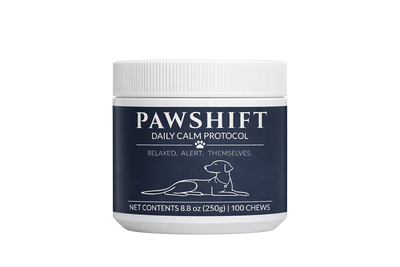
The Daily Calm Protocol
Daily support for apartment dogs with repeating workday triggers. 7 active ingredients. Published doses. No proprietary blends.
View the Full Protocol🔒 60-Day Money-Back Guarantee · Free Shipping · One-Time Purchase
ADVERTORIAL DISCLOSURE: This page is an advertisement for PawShift and is intended for informational purposes only. It does not constitute medical or veterinary advice. Please consult your veterinarian regarding any change in your dog’s care. Individual results may vary. PawShift products are not drugs and are not intended to treat, prevent, or cure any disease.